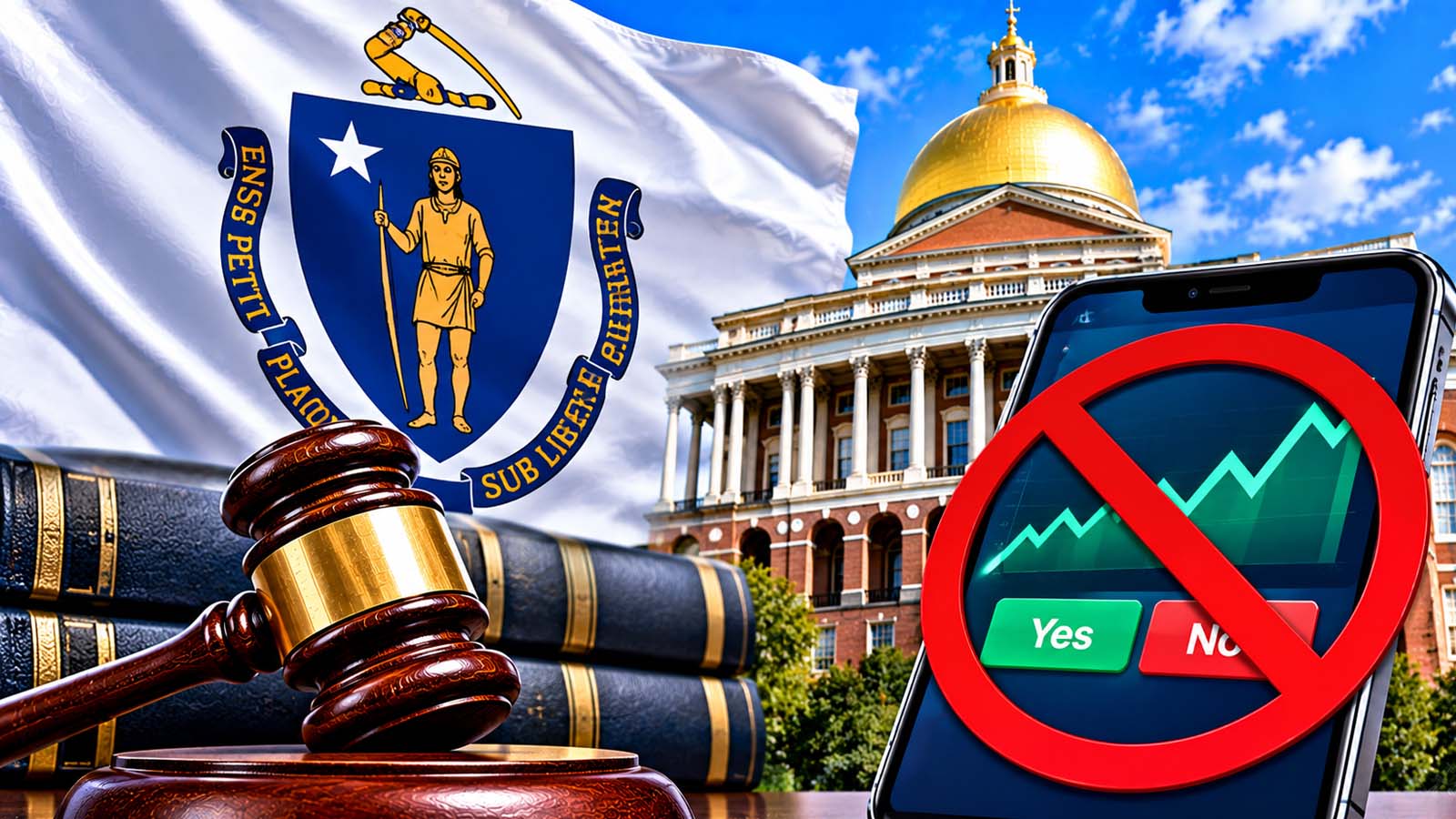
- Unlicensed sports wagers on prediction market platforms violate Massachusetts law, Gaming Commission Chair Jordan Maynard told a House panel.
- The platforms list college player props Massachusetts prohibits, and most accept customers at 18, three years under the state minimum, Maynard wrote.
- Kalshi is appealing to the state Supreme Judicial Court after a lower court enjoined it in the Massachusetts attorney general’s suit.
- Consumers who assume the commission regulates prediction markets seek relief the Commodity Futures Trading Commission does not offer, Maynard wrote.
BOSTON – Massachusetts Gaming Commission Chair Jordan Maynard told a U.S. House subcommittee in written testimony that prediction market operators taking sports wagers with no state license “are breaking Massachusetts law.” The state bars wagers on an individual college athlete’s performance and any bet by a person under 21, Maynard wrote, while prediction markets list those props now and most of the platforms accept customers at 18.
The testimony went to the House Subcommittee on Higher Education and Workforce Development for its Nov. 11 hearing on sports gambling on college campuses. Much of it catalogs the limits Massachusetts places on betting around college sports.
What Massachusetts Requires Of Licensed Sportsbooks
Under Massachusetts sports betting rules, no one younger than 21 may wager, and operators may not advertise on a college campus or in or near an arena hosting a college game. Props on a single college athlete are off the board for every collegiate event, Maynard wrote, and a Massachusetts school can be bet on only during tournament play such as March Madness.
Age-verification technology required of licensed operators has turned away no fewer than 11,000 underage sign-up attempts, Maynard wrote. Research the commission paid for at the Boston University School of Public Health put the under-21 share of college sportsbook app users at 34% nationally and about 22% in Massachusetts.
Prediction market platforms face none of those requirements, Maynard wrote.
The Gap For Massachusetts Bettors
By Maynard’s account, a resident aged 18 to 20 cannot open a licensed sportsbook account but can open one on most prediction market platforms. Prediction markets are also offering wagers on an individual college player’s performance, a bet no licensed Massachusetts sportsbook may take. The testimony cites the Commodity Futures Trading Commission’s industry filings for the contracts.
Maynard wrote that the props ban keeps any bettor’s stake from hinging on a single student-athlete. He cited an NCAA survey as the reason for the commission’s Bet on Respect program. In the NCAA’s February release of that survey, 51% of men’s basketball players in Division I said they were abused on social media over how they played, and 46% said a person who had wagered on their game sent them “negative or threatening messages.”
Anyone found harassing an athlete, coach or other participant can be shut out of all of the state’s licensed sportsbooks and casinos under Bet on Respect.
Federal Law And The Kalshi Case
“Prediction market companies are offering sports wagers and calling them something else to avoid state laws, taxes, and regulatory requirements,” Maynard wrote. He also disputed the markets’ federal-law argument. If the 2010 Dodd-Frank Act had opened the door to sports contracts, he wrote, prediction markets would have listed them years ahead of the 2018 ruling that struck down PASPA, the federal sports betting ban.
The testimony also points to the state’s case against Kalshi. The attorney general’s office went to state court in September 2025 asking for an order halting Kalshi’s operations under the state sports wagering law, Maynard wrote. It won an injunction, and Kalshi’s appeal is before the Massachusetts Supreme Judicial Court.
Where Consumer Complaints Go
Consumers contact the commission regularly on the assumption that it oversees sports prediction markets, Maynard wrote, asking for “rules clarification, consumer protection relief, or responsible gaming help.” The CFTC provides none of that, he wrote, calling the agency “simply not equipped to or interested in regulating nationwide consumer sports betting markets.”
Licensed sportsbooks answer to the commission’s Investigations and Enforcement Bureau, which has 34 members, and to a 14-member Massachusetts State Police Gaming Enforcement Unit. Maynard wrote that their investigations have ended in fines 39 times, with operators paying the state more than $1 million and returning nearly $10 million to customers. Those remedies exist inside the state’s legal sports betting system, which he wrote the prediction market platforms bypass.
What Maynard Wants
Maynard urged regulators at every level to ban prop bets on college players, pay for national prevention research and take up the other youth protections in his testimony. Sports wagering should stay under state regulation, he wrote, with federal officials working alongside state regulators on consistency and the sharing of information and best practices.
