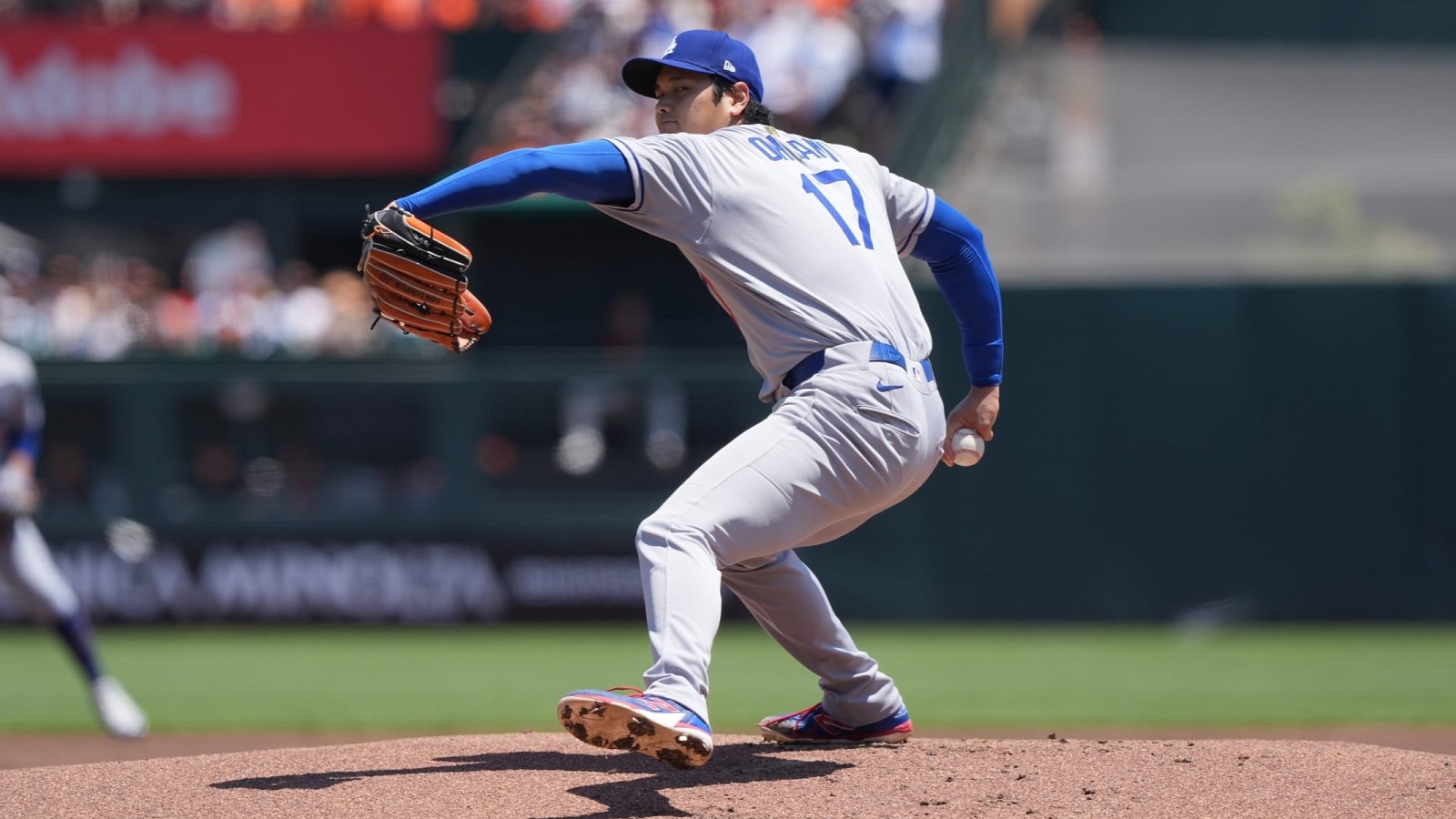
- Ohtani leaves the Dodgers rotation indefinitely, pausing a run of 95 strikeouts and a 1.79 ERA.
- He stays the everyday designated hitter because the sore left knee is his back leg when batting.
- His .413 xwOBA sits above his .397 wOBA, meaning the contact has outrun the results.
- A 14.3% walk rate is the trap, since walks pay nothing on total-bases and hits props.
LOS ANGELES – Shohei Ohtani is out of the Dodgers rotation indefinitely, taking a 1.79 ERA and 95 strikeouts off the second-half prop board while his bat stays in the lineup every day.
No Timetable, but the Dodgers Still Expect Him Back
Ohtani will not make his scheduled Wednesday start in Philadelphia, and the Dodgers have set no timetable for his return to the mound, manager Dave Roberts said Sunday.
“Where we’re at right now, how we’re proceeding, I would say that it’s going to be some time,” Roberts said. “I’d say that it’s not going to be a day-to-day thing.”
Roberts also said Ohtani would pitch again this season and called the move somewhat precautionary, so this is a shutdown with a soft edge rather than a season-ending one. The soreness first surfaced in a June 11 game at Pittsburgh and lingered through the All-Star break despite a lubricant injection in the knee.
What comes off the board with him was the best pitching of his career, built across 85 2/3 innings and 14 starts. League-average run prevention is roughly 4.10, so his ERA ran at well under half the league’s rate. That was not a hot stretch to fade.
Any market built on his strikeout total, his outs recorded or his opponent’s runs is simply gone until the Dodgers name a date.
The Bat Stays, and Statcast Says It’s Underrated
The mechanism matters for anyone pricing the rest of his season. The left knee is Ohtani’s landing leg when he pitches and his back leg when he hits, which is why the soreness followed his starts and not his at-bats, and why he keeps the designated hitter job.
The underlying numbers say that bat is better than its surface line. Ohtani is hitting .290/.398/.540 with 22 home runs and a .397 wOBA, elite territory when roughly .320 is league average and .370 clears the bar. His expected wOBA, per Baseball Savant, is .413, and that gap points one direction: the contact quality has outrun the results, not the other way around.
The batted-ball inputs back it up. A 17.2% barrel rate more than doubles the 6% to 8% league norm, his 52.9% hard-hit rate towers over a roughly 40% average, and his 93.4 mph average exit velocity sits well clear of the 89 mph baseline. Those inputs stabilize far faster than batting average, so this is signal rather than a two-week mirage.
A 14.3% Walk Rate Is a Total-Bases Problem
Here is where the obvious bet gets expensive. Ohtani is walking 14.3% of the time against a league baseline near 8.5%, and a walk produces no total bases and does not count as a hit. Roughly one trip in seven ends in the single most valuable outcome for his team and the least valuable one for a total-bases or hits ticket. The same plate discipline that makes him a nightmare to face quietly suppresses the counting props people rush to buy.
That is the discipline the whole exercise demands. A legal sports betting prop price tells you what the outcome pays, never how likely it is. The edge is the gap between how often something actually happens and what the number implies, so a star’s name on the ticket is not a reason to take a short price.
The team-level picture is a separate market, and the NL pennant odds tracker follows that board. Books will repost his hitting markets across the rest of the MLB season as the Dodgers settle the rotation, and the board reprices around his bat rather than his arm. Until the Dodgers set a timetable, the only Ohtani props available are the ones he takes into the batter’s box.
