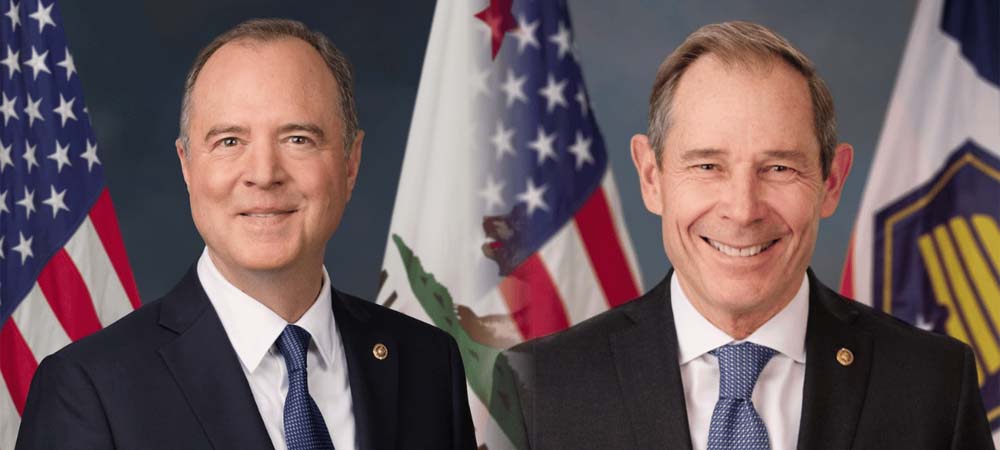
- Senators Schiff and Curtis introduced a bipartisan bill to ban sports-related contracts on federally regulated prediction markets.
- Prediction market apps operate under federal rules, allowing them to offer sports contracts even in states where betting is restricted.
- The bill aims to close a loophole that has allowed these platforms to bypass state sports betting laws nationwide.
WASHINGTON – What was once a quiet jurisdictional gap has exploded into a full blown Senate battle, as federally regulated online platforms continue to chip away at the sports betting authority states have guarded for years.
The Prediction Markets Are Gambling Act was presented on Monday by Senators John Curtis of Utah and Adam Schiff of California. This is the first bipartisan Senate bill that directly targets prediction markets for their sports-related offers. Offering contracts based on sporting events or casino-style games would be prohibited for any platform under CFTC supervision, according to the bill.
What Are Prediction Markets, and Why Do They Matter?
Prediction market apps like Kalshi and Polymarket operate on a vastly different model than a typical sportsbook. Users purchase and sell contracts based on anticipated results rather than betting against the house at predetermined odds. Similar to how stocks move on an exchange, the value of those contracts varies based on what other traders think.
These platforms have claimed that because of their structure, they are subject to federal jurisdiction rather than state gambling laws since they function as financial exchanges rather than gambling sites. They are able to operate in places where sports betting is prohibited or subject to limitations because of this reasoning, something that traditional sportsbooks are not allowed to do.
Millions of Americans still live in states where legal sports betting has not been regulated at the local level, as only 39 states and Washington, D.C. permit regulated wagering.
That loophole is directly targeted by the measure. Schiff cited trading levels as proof of the scope of the problem, pointing out that Super Bowl trading exceeded $1 billion in 2026 and a March Madness contract recently surpassed $100 million in activity.
Curtis stressed that rather than a federal commodities regulator, states with sports betting regulations should be in charge of what occurs within their respective boundaries.
The bill is presently awaiting additional action in the Senate, where it must pass committee review before moving on to a floor vote.
